
Hennessey Venom GT
A Lotus-based hypercar that chased speed records.

via Wikipedia: Hennessey Venom F5 · see source
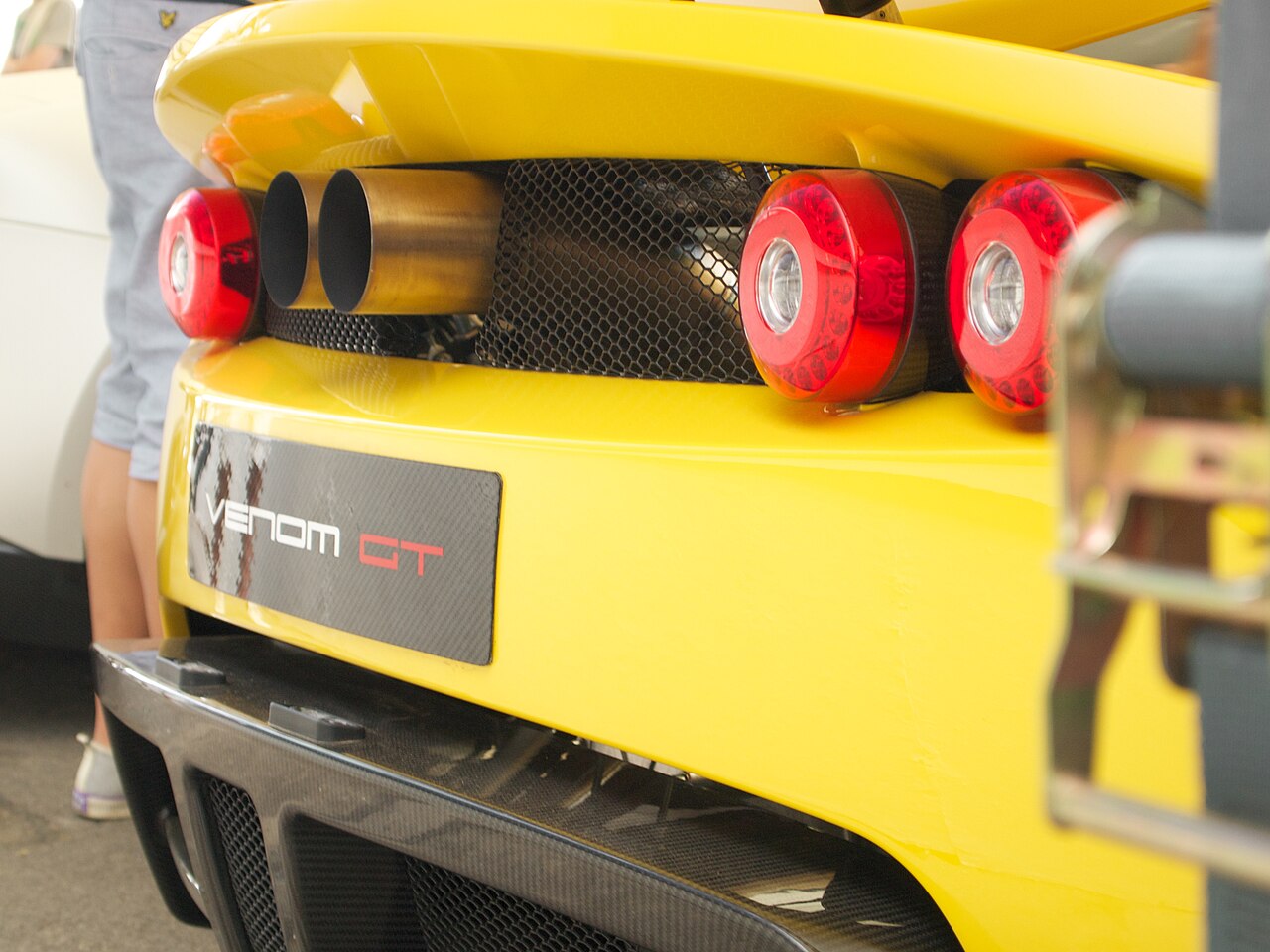
The Hennessey Venom GT is a high-performance sports car developed by Hennessey Performance Engineering. Based on a heavily modified Lotus Elise/Exige chassis, it is known for extreme speed and acceleration, setting multiple world records despite not being a series production car.
- Manufacturer
- Hennessey Performance Engineering
- Production years
- 2011–2017
- Engine
- Twin-turbocharged 7.0L GM LS7 V8
- Power output
- 1,244 hp (928 kW) at 6,600 rpm
- Curb weight
- 2,743 lb (1,244 kg)
- Top speed (unofficial)
- 270.49 mph (435.31 km/h)
- 0–186 mph time
- 13.63 seconds (Guinness World Record)
Verified Timeline
Lore & Background
The Venom GT was developed by Hennessey Performance Engineering, a US tuner and manufacturer. It retained many Lotus Elise/Exige components, including the roof, doors, and windscreen, but was heavily modified with carbon fiber bodywork and a twin-turbocharged 7.0L V8 engine. The car was registered for road use as a modified Lotus Exige and was not a series production car. It also achieved an unofficial 0–200 mph time of 14.51 seconds. The Spyder was limited to five units plus a one-off Final Edition. The Venom GT was succeeded by the Hennessey Venom F5 in 2017.
Reader's Guide
The Hennessey Venom GT occupies a unique place in automotive history as a low-volume, extreme performance car built on a modified Lotus platform. Its significance lies in its record-breaking acceleration and top speed achievements, which challenged established hypercar manufacturers. However, its status as a record holder is complicated by its limited production—only 29 cars were built, falling short of the 30 required for Guinness World Records' production car category. The Venom GT's legacy is that of a tuner-built machine that pushed boundaries, but its successor, the Venom F5, was designed as a ground-up series production car, marking a shift toward full manufacturer status. The car's adjustable power settings and active aerodynamics demonstrated Hennessey's engineering ambition, while the Spyder variant's origin with a celebrity request added a touch of pop culture lore.
Did You Know?
- Only 29 Venom GT cars were built, falling short of the 30 required for Guinness World Records' production car category.
- The Venom GT was succeeded by the Hennessey Venom F5 in 2017.
Engineering & Powertrain
The heart of the Venom F5 is Hennessey's own Fury engine, a twin-turbocharged 6.6-liter V8 that generates up to 1,817 horsepower and 1,193 pound-feet of torque. For owners who want even more, the Evolution package—priced at an additional $285,000—pushes output to 2,031 horsepower by running E85 fuel and claims a 0-to-200-mph sprint of just 10.3 seconds. Power reaches the rear wheels through a CIMA-supplied seven-speed single-clutch automated manual gearbox with paddle shifters and a limited-slip differential. The entire chassis and body are constructed almost entirely from carbon fiber, keeping the car's weight at approximately 2,950 pounds with fluids aboard. That yields a remarkable power-to-weight ratio of 1,358 horsepower per ton. The concept car's sleek active-aerodynamics design achieved an estimated drag coefficient of 0.33, while the production variant, which swaps active aero for a smaller fixed spoiler, carries a slightly higher figure of 0.39.
Production & Exclusivity
Hennessey capped total production of the standard Venom F5 at just 24 units. By December 2020, half of those had already found buyers at an initial U.S. price of $1.6 million; the remaining twelve carried a raised sticker of $2.1 million. In August 2021, the company confirmed that all 24 slots were spoken for. The lineup expanded with the Venom F5 Revolution, a track-focused variant limited to 36 cars—24 coupes and 12 roadsters, with the open-top allocations already sold out. Priced around $2.7 million, the Revolution receives revised aerodynamics, retuned suspension, lighter wheels, a roof-mounted air intake, and onboard digital telemetry. Chief Engineer John "Heinrocket" Heinricy, a former GM performance specialist behind the Cadillac CTS-V and Corvette Z06, led the Revolution's development and called it the most demanding project of his career. Hennessey's Maverick division further extended the family with a one-of-one Venom F5 Revolution LF.
The Pursuit of Speed
The very name "F5" is a nod to the highest rating on the Fujita tornado scale, a category reserved for winds reaching 261 to 318 miles per hour. Hennessey set its sights on that upper boundary, targeting a top speed in excess of 311 mph—500 km/h—to claim the title of world's fastest production car. While that ultimate benchmark remains the company's stated goal, a concrete milestone arrived on July 30, 2024, when John Hennessey himself piloted a Venom F5 down a stretch of road in Florida, USA. The car shattered the standing one-half-mile record for production vehicles, covering the 805-meter distance in 14.44 seconds at a top speed of 219 mph (353 km/h). That run demonstrated the Fury engine's raw straight-line capability and the carbon-fiber structure's ability to handle extreme loads. For a marque that has built its identity around pushing the envelope of automotive speed, the Florida record served as both a validation of the F5's engineering and a stepping stone toward the 500-kilometer-per-hour dream that has driven the project since its inception.
From Concept to Customer
The Venom F5 first appeared to the public in August 2014, but it was not until November 1, 2017, at the SEMA Show in Las Vegas, that an exterior mock-up was displayed. That concept featured three exhaust tips and active aerodynamics, neither of which survived into the production car, which instead carries four exhausts and a smaller fixed spoiler. Development was contracted to Delta Motorsport at its Silverstone, England facility—the same team that built every previous-generation Venom GT for Hennessey. Hennessey itself became an accredited titled manufacturer in 2017, making the F5 its first wholly proprietary vehicle. Inside, the company stressed space, quality, and comfort, noting that an undisclosed NFL player standing 6 feet 7 inches tall has ordered one of the first production cars. Every F5 ships with a "Treasure Chest," a large aluminum box holding the key fob, a magnetic trickle charger, and a tow hook. The key fob's serial-number plate is machined from a metal component salvaged from a Space Shuttle launch, a piece John Hennessey received from an astronaut and broke into fragments so each owner could hold "a piece of space."
Common Misconceptions (Editorial)
- Some believe the Venom GT is a fully original hypercar, but it is actually based on a heavily modified Lotus Elise/Exige chassis, retaining the roof, doors, and windscreen. - It is often assumed to be a production car eligible for official records, but only 29 were built—falling short of the 30 needed for Guinness World Records' production car category. - The Venom GT is sometimes confused with a series production model, but it was registered for road use as a modified Lotus Exige and was not a series production car.
Why It Matters (Editorial)
The Hennessey Venom GT endures as a symbol of audacious American tuning, proving that a heavily modified lightweight platform could challenge—and unofficially beat—the world’s most exotic supercars. Its legacy lies in the sheer audacity of its engineering, pushing boundaries with a twin-turbo V8 in a Lotus shell, even if its limited production kept it from official record books.
Gallery





Frequently Asked Questions
What is the Hennessey Venom GT?
It is a limited-run American hypercar produced by Hennessey Performance Engineering from 2011 to 2017. The car was built around a heavily modified Lotus Elise/Exige platform and pushed well beyond anything Lotus originally offered.
What engine and power output does the Hennessey Venom GT have?
It is powered by a twin-turbocharged 7.0-liter GM LS7 V8 that produces 1,244 horsepower at 6,600 rpm. That enormous output is delivered through a chassis that weighs just 2,743 pounds, giving the car a staggering power-to-weight ratio.
How fast is the Hennessey Venom GT?
The car logged an unofficial top speed of 270.49 mph (435.31 km/h), making it one of the quickest production-based cars of its time. Because only a handful were ever built, that figure is commonly cited as unofficial rather than a certified record.
What is the Hennessey Venom GT based on?
The underlying chassis comes from a Lotus Elise/Exige, reworked extensively to house the massive twin-turbo V8 and its supporting systems. Hennessey essentially took Lotus's lightweight architecture and grafted a far more powerful American powertrain onto it.
Why is the Hennessey Venom GT significant in supercar history?
It demonstrated that a small U.S. tuning shop could build a car that matched or beat European hypercars in raw straight-line speed. Its record-setting runs, despite the car never being a true series-production model, solidified Hennessey's standing as a credible high-performance manufacturer.
More in Supercars 1-20
Spotted an error? Know more?
This is a living reference — every entry is fact-audited, and reader corrections feed straight into our audit queue. Suggest an edit · See this site's audit record